
Stop Thinking Outside the Box. Start Questioning the Box You’re In.
Why the most popular creativity advice in business has stopped working, and what serious teams do instead.
Walk into any leadership offsite, innovation workshop, or strategy retreat in Singapore this year and you will hear the same instruction at least once. Think outside the box. The phrase is so familiar it barely registers anymore. It sits alongside “blue sky thinking” and “no bad ideas” as one of those things facilitators say to fill the air before the real conversation starts.
Here’s the problem. After three decades of telling people to think outside the box, we have very little to show for it. Innovation programmes still stall. Strategy decks still recycle the same ideas. Restructures still produce the same friction between the same teams. The advice sounds liberating, but in practice it sends people on what one researcher has called a cognitive wild goose chase. They generate longer lists of ideas. Almost none of them get built.
If thinking outside the box really worked, the workplace would look very different by now.
Where The Phrase Actually Came From
The cliche has an origin most people have forgotten. It comes from a puzzle that has been circulating in management training rooms since at least the 1970s. Nine dots arranged in a three-by-three grid, with the challenge to connect all of them using only four straight lines. The trick is to extend your lines past the boundary of the grid. The boundary itself was never the rule. You imposed it.
That was a useful insight in a training context. It revealed something real about how we add constraints that nobody actually set. But the metaphor got promoted into a universal principle of business creativity, and that’s where the trouble began. The puzzle has one correct answer. Real organisational problems do not. Telling a finance team in a Singapore bank to think outside the box about cost reduction does not produce the same insight as drawing one extra line on a piece of paper. It produces a meeting full of vague ideas and a quiet sense that everyone is performing creativity rather than doing it.
Subsequent research has been even less kind to the cliche. Studies have found that simply telling people to think more freely does not improve the quality of their ideas. In some settings it actively hurts focus, because removing structure does not make minds more creative. It makes them more scattered.
What the advice actually produces
Spend enough time in workshops and you start to notice the pattern. Outside-the-box thinking, in practice, tends to produce three things.
The first is idea soup. Teams generate dozens of suggestions of wildly varying quality and then run out of energy before they can sort them. The walls fill up with sticky notes. Nothing moves to a decision.
The second is performative creativity. People throw out increasingly unusual ideas because the implicit reward in the room is unconventionality, not usefulness. Whoever says the most surprising thing gets nodded at. The quiet person with the practical insight does not speak up.
The third is no follow-through. Because the conversation never anchored itself to anything specific, nobody has a clear sense of what to do on Monday morning. The session was energising. The work afterwards is exactly the same as before.
This is not a problem with the people in the room. It is a problem with the instruction. You cannot ask a team to think differently without first asking them what they are currently thinking, and why.
The Harder Question
Here is the shift. Instead of asking your team to leave the box behind, ask them to describe the box they are in.
What are the assumptions everyone is working from? Which of those assumptions are real constraints, like a regulator or a budget, and which are imagined ones, like “we have always done it this way” or “the CEO would never go for it”? Which boundaries were drawn on purpose, and which ones just appeared one day and never got questioned by anyone since?
This is harder than brainstorming, because it requires honesty. The hidden assumptions running a team are often the ones the most senior people in the room are most invested in. Surfacing them feels risky. But until they are surfaced, every creative session is just rearranging the furniture inside an invisible cage.
There is a serious body of work that supports this shift. Drew Boyd and Jacob Goldenberg’s research on structured innovation argues that constraints, properly identified, are what drives genuine creativity, not freedom from constraints. Genrich Altshuller’s earlier work on inventive principles, developed from analysing hundreds of thousands of patents, pointed in the same direction. The most useful creative move is rarely to escape the system. It is to understand the system well enough to see which parts are load-bearing and which parts are decoration.
For leaders, this is also a more honest framing. Your team is not failing to be creative. They are succeeding at operating inside a box that nobody has named out loud.
What This Looks Like in A Real Team
A few practical signs that a team needs to question its box rather than escape it.
Meetings that produce decisions which never get implemented. The decisions feel correct in the room. They lose energy the moment people return to their desks. Usually this means a constraint that nobody mentioned is still quietly in force, and the decision contradicts it.
Strategies that look bold on a slide and conservative in execution. The deck talks about transformation. The roadmap describes incremental improvements to last year’s plan. Somewhere between the strategy and the execution, an unspoken assumption survived intact.
Cross-functional projects that stall at the same handoff every time. The same friction, between the same two teams, on every project. The friction is not really about personalities. It is about a shared assumption that neither team has ever examined together.
In each of these cases, no amount of outside-the-box thinking will help. The team needs to look squarely at what they have been assuming, often for years, and decide which of those assumptions still serve them.
Where The B❒X Comes In
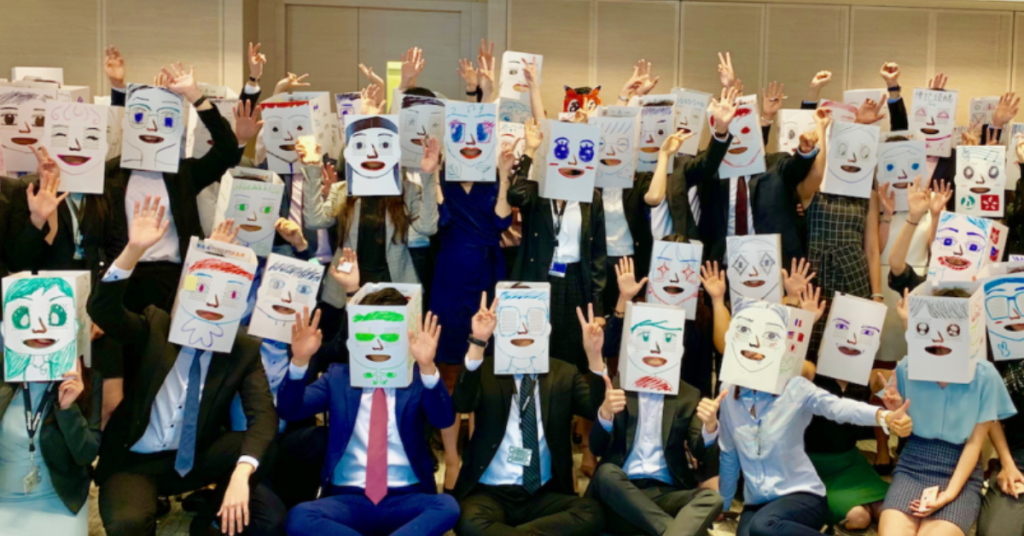
This is the kind of work The B❒X Experience by InnoGreat was built to do. Jimbo Clark’s method takes a deceptively simple physical object, the box itself, and uses it as a tool for making hidden assumptions visible. Teams learn to identify the box they are operating in, examine which parts are real and which are imagined, and then decide what kind of box would actually serve them better.
It is not a workshop about being more creative in the abstract. It is a workshop about seeing your own thinking clearly enough to change it.
The teams who get the most from it tend to be the ones already stuck. Leadership groups navigating a restructure. Cross-functional teams that have been having the same argument for years. Strategy committees whose annual retreats keep producing variations on the same plan. In each of those situations, what’s needed is not a wilder idea. It is a clearer one. A team finally naming the assumption that has been quietly running the room.
For HR and L&D leaders in Singapore, this matters because it changes what a creativity or innovation programme can actually deliver. Instead of returning to work with a list of clever ideas and no obvious next step, teams return with a shared understanding of what they had been taking for granted, and a real decision about what to do differently. That sticks. The energy from a normal workshop fades by Wednesday. The clarity from a box conversation tends to last.
One Closing Thought
The next time someone in a meeting suggests thinking outside the box, you don’t need to roll your eyes. The instinct is right. The phrasing has just gotten old. What the team almost always needs is not freedom from constraints, but clarity about them.
Ask the harder question. What box are we in right now, and who put us here? The answers are usually closer to the surface than anyone expects, and once they are in the open, the better ideas tend to follow on their own.